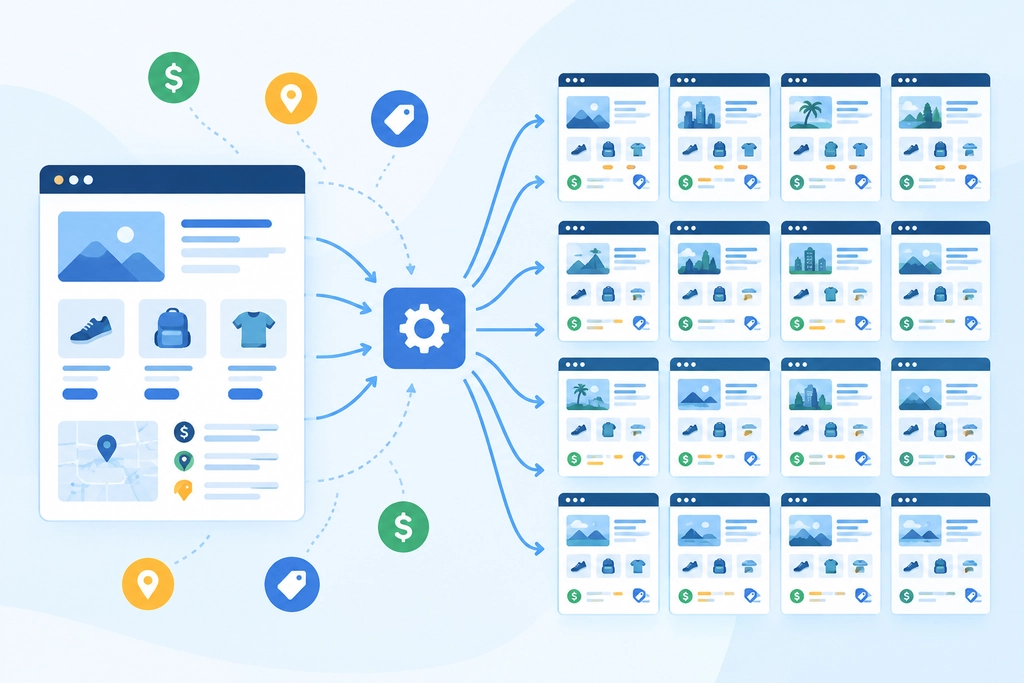
Programmatic SEO best practices 2026 center on unique data, strict quality thresholds, and templates built for search intent rather than keyword volume alone.
What is Programmatic SEO?
Programmatic SEO is a method of generating many search-optimized pages at once by combining a dataset with a page template. Instead of writing 500 city-specific landing pages by hand, a team builds one template and feeds it location data, pricing data, or product specs to populate each version automatically.
The approach rests on three pieces: a structured dataset, a repeatable template, and a publishing system that handles indexing and internal linking. Each page targets a distinct, narrow search query, often with low individual search volume.
This matters because 94.74% of all keywords get 10 or fewer searches a month, according to Ahrefs data cited by Discovered Labs. No single page will carry a site, but thousands of small pages add up to meaningful collective traffic.
Common data sources include public APIs, internal product catalogs, pricing feeds, and government or industry datasets. Jasmine Directory recommends a minimum of 1,000 unique data points before launching a dataset-driven page set, since smaller datasets tend to produce repetitive, low-value pages.
Done well, this differs sharply from manual content production, where effective programmatic SEO techniques replace the slow pace of writing 8 to 12 blog posts a month with systems that can publish thousands of pages while still meeting Google’s quality bar. Done poorly, it produces exactly the kind of thin, repetitive pages search engines now penalize.
Key Statistics and Facts
The numbers behind programmatic SEO in 2026 tell a story of concentration, not distribution. Most traffic goes to a small share of pages, even on large, high-authority domains.
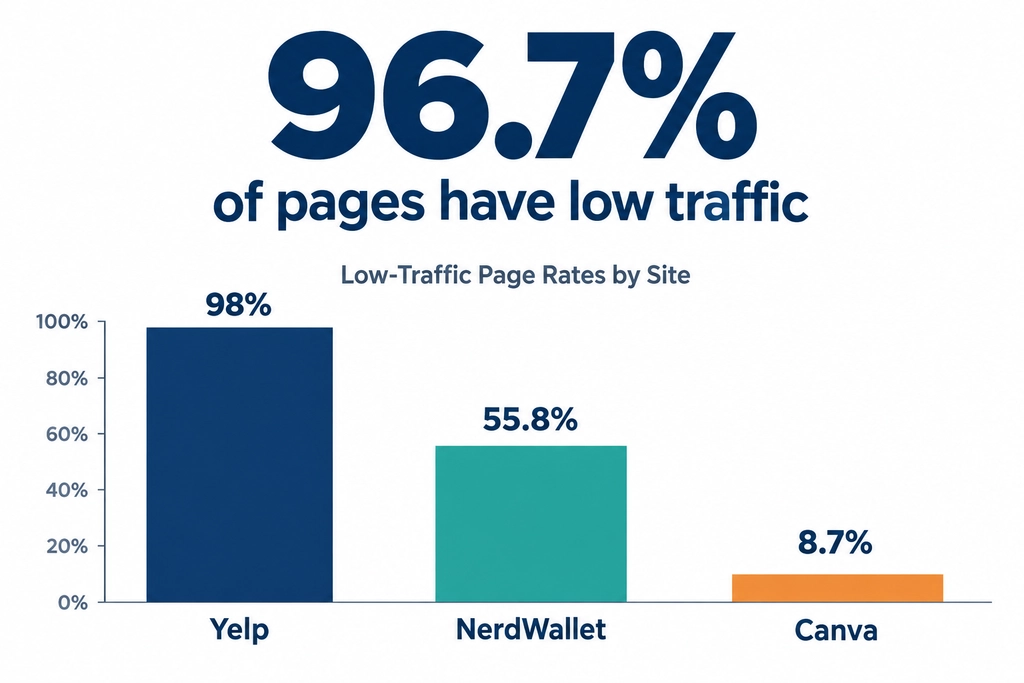
Even strong domains show wide gaps. Canva clears 1,000 visits on 8.7% of its pages, while Yelp and NerdWallet sit at 98% and 55.8% of pages stuck at 100 visits or fewer. Domain authority alone does not rescue thin long-tail pages, per the SEO Savages study.
Programmatic SEO vs Traditional SEO
Traditional SEO relies on individually researched and written pages, usually a handful per month. Programmatic SEO instead builds one template and applies it across a dataset, producing hundreds or thousands of pages in the same timeframe.
The trade-off is depth versus reach. A hand-written guide can cover a competitive, high-volume term in detail. A programmatic page targets a narrow, specific query, like a single city, currency pair, or product comparison, and wins by matching intent precisely rather than by depth of coverage.
| Attribute | Traditional SEO | Programmatic SEO |
|---|---|---|
| Output volume | 8 to 12 posts/month (typical B2B SaaS team) | Hundreds to millions of pages |
| Keyword targets | High-volume, competitive terms | Long-tail terms, often under 10 searches/month |
| Time to results | Varies, often slower initial ramp | 3 to 6 months per HubSpot |
| Risk profile | Lower risk of thin-content penalties | Higher risk without strict quality controls |
Neither approach replaces the other. Most sites that scale well, including Zapier and Wise, run both best programmatic SEO strategies 2026 alongside traditional editorial content, using templates for scale and manual writing for competitive head terms.
Successful Implementation Strategies
Effective programmatic SEO techniques start with the dataset, not the template. A page is only as useful as the data behind it, so teams should confirm they have at least 1,000 unique data points, per Jasmine Directory’s threshold, before building out a template.
- Audit your data source for completeness, accuracy, and update frequency before writing a single template.
- Build a template that answers the specific query behind each page, not a generic restatement of the dataset.
- Keep each page at least 60% different in wording and structure from its siblings, the threshold Metaflow cites to avoid duplicate-content flags.
- Set up internal linking between related pages, such as linking a currency converter page to a broader guide on sourcing reliable datasets for pseo.
- Launch a sample batch of 50 to 100 pages first, monitor indexing and ranking behavior, then scale once the pattern holds.
- Prune or merge pages that fail to gain traction after 3 to 6 months, the typical window HubSpot cites for meaningful pSEO results.
Quality control matters more than volume. SEO Savages found that across the programmatic pages it studied, only 3.3% reached a strong page-quality success rate, meaning the vast majority of launched pages simply never earned the signals needed to rank.
Internal structure also plays a role search engines reward. Tripadvisor ranks for more than 100,000 keyword variants of “things to do in,” according to Backlinko, largely because each page links cleanly to related city and category pages rather than sitting in isolation.
Teams following 2026 programmatic SEO tips should also plan for canonicalization early. Wise canonicalizes its 8.5 million currency pages to avoid duplicate indexing issues, a step many smaller pSEO projects skip and later regret. Combining this with a clear process for designing scalable page templates and a review cycle tied to routine content audits for programmatic pages gives a dataset-driven project the structure it needs to survive algorithm updates rather than collapse after the next one.
Case Studies of Successful Programmatic SEO
Real deployments show both the upside and the groundwork required. Gyfted, working with the SEO Savages team, grew organic users by 1.2 million a year through a structured programmatic rollout rather than a single large page dump.
In a separate case, Prawomat launched 1,125 programmatic pages built around specific legal query variants, choosing a smaller, tightly scoped dataset over a sprawling one.
TripleDart, meanwhile, has applied programmatic SEO strategies 2026 teams now reference across 50 B2B SaaS clients, pairing template-driven pages with the kind of editorial support that keeps thin pages from piling up.
A rough timeline across these projects follows a common pattern: dataset and template build in month one, a limited pilot batch in month two, indexing and ranking monitoring through month four, and a pruning or scaling decision by month six. This mirrors the 3 to 6 month timeline HubSpot cites for meaningful results.
What ties these cases together is restraint. None of them published without a quality gate, and all of them treated the first batch as a test rather than a finished strategy, a pattern worth following for anyone setting programmatic SEO guidelines for 2026 inside their own team.
Final Thoughts and Future Trends
Programmatic SEO best practices boil down to data quality, strict variation thresholds, and disciplined pruning, not raw page count. With 96.7% of pages across 12.3 million studied by SEO Savages stuck under 100 monthly visits, the lesson is clear: scale without a quality gate wastes effort.
Expect tighter scrutiny from search engines on thin, templated pages, alongside continued reward for sites like Wise and Booking.com that pair large datasets with canonicalization and internal linking discipline. Teams that treat each page as answering a real query, backed by at least 1,000 data points and 60% content variation, stand the better chance of landing in the 0.3% that actually perform.
Key data summary
| Metric | Value | Source | Year |
|---|---|---|---|
| Programmatic pages analyzed in SEO Savages study | 12.3 million pages | SEO Savages | 2026 |
| Pages getting 100 visits/month or fewer | 96.7 percent | SEO Savages | 2026 |
| Pages clearing 1,000 visits/month | 0.3 percent | SEO Savages | 2026 |
| Canva pages clearing 1,000 visits/month | 8.7 percent | SEO Savages | 2026 |
| Wise pages clearing 1,000 visits carrying total traffic share | 80 percent | SEO Savages | 2026 |
| NerdWallet pages at 100 visits or fewer | 55.8 percent | SEO Savages | 2026 |
| Yelp pages at 100 visits or fewer | 98 percent | SEO Savages | 2026 |
| Wise currency converter pages total | 8.5 million pages | Backlinko | 2026 |
| Wise sitemap index sitemaps count | 170 sitemaps | Backlinko | 2026 |
| Booking.com pages targeting property rentals | 8 million pages | Omnius | 2026 |
| Booking.com monthly visitors | 70 million visitors/month | Omnius | 2026 |
| Zapier monthly visitors from pSEO | 2.3 million visitors/month | TripleDart | 2026 |
| B2B SaaS organic search ROI | 702 percent | TripleDart | 2026 |
| Keywords with 10 or fewer monthly searches | 94.74 percent | Discovered Labs | 2026 |
| Minimum unique data points needed for a pSEO dataset | 1000 data points | Jasmine Directory | 2026 |
Methodology
Data draws from a mix of case studies and one large-scale page analysis (SEO Savages), so figures reflect a sample of large, high-authority sites rather than the full range of programmatic SEO campaigns. Traffic figures for named companies (Zapier, Booking.com, Wise) come from third-party estimates, not direct platform data, and may shift over time as sites update their page counts and content strategy.
- Sources consulted: 9
- Sources cited: 5
- Data range: 2026 publications, accessed October 2026
- Freshness: 5 current-year, 0 last-year, 0 older
- Update schedule: Quarterly
Frequently Asked Questions
What is programmatic SEO and how does it work?
Programmatic SEO means building many pages from templates and data sets, so each page targets a different search term automatically. Wise uses this method for currency converters, with 8.5 million pages spread across 170 sitemaps. The goal is to cover thousands of small, specific searches instead of writing each page by hand.
Does programmatic SEO still work in 2026?
It can work, but most pages fail. A study of 12.3 million programmatic pages across nine large sites found that 96.7% got 100 visits a month or fewer. Success depends on picking data-rich topics and giving each page a real reason to exist, not just swapping a city or product name into a template.
What percentage of programmatic pages actually get traffic?
Very few. Across the sites studied, only 0.3% of pages cleared 1,000 visits a month, even though these sites carry strong domain authority (Domain Rating 89-94). This shows that a trusted domain does not guarantee results for thin, auto-generated long-tail pages.
Can small keyword searches still add up to real traffic?
Yes. Ahrefs data shows 94.74% of all keywords get 10 or fewer searches a month. Programmatic SEO is built to catch these small queries one page at a time, so even modest per-page traffic can add up to a large total when the pages are built well.
What companies have succeeded with programmatic SEO?
Zapier reached 2.3 million monthly visitors through programmatic integration pages, and Booking.com drives more than 70 million monthly visitors from over 8 million property pages. These cases show the method works at scale, but both sites also invest heavily in page quality and data accuracy behind each template.
Is programmatic SEO worth it for B2B SaaS companies?
It can pay off well. B2B SaaS companies that put money into SEO see an average 702% return on investment from organic search. Since manual content teams usually publish only 8 to 12 blog posts a month, programmatic methods let SaaS companies cover far more search terms than hand-written content alone.
Why do most programmatic SEO pages fail to rank?
Many pages fail because they repeat the same template with small word swaps and add little new information. The SEO Savages study found 98% of Yelp pages get 100 visits a month or fewer, compared to 55.8% on NerdWallet, showing that data depth and page usefulness matter more than page count.
How many pages should a programmatic SEO project launch with?
There’s no fixed number, but quality should come before volume. Canva’s template pages clear 1,000 visits a month at a rate of 8.7%, far above most sites in the SEO Savages study, which suggests a smaller batch of well-built pages often beats a huge batch of thin ones.
Do a small number of pages usually carry most of the traffic?
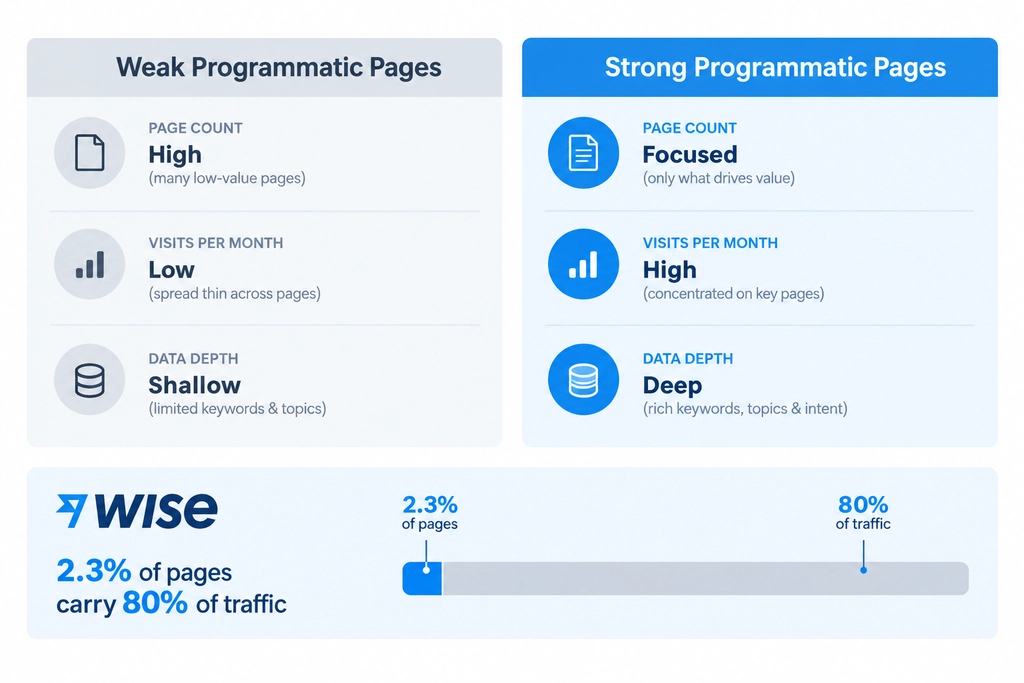
Often, yes. On Wise, just 2.3% of pages clear 1,000 visits a month, yet those pages bring in 80% of the site’s total traffic. This pattern is common in programmatic projects, where a small set of strong pages carries most of the weight while the rest sit quietly.
What’s the biggest mistake to avoid with programmatic SEO in 2026?
The biggest mistake is treating template page creation as a numbers game. With 96.7% of pages in a 12.3-million-page study getting 100 visits a month or fewer, piling on more thin pages rarely helps. Focus instead on strong underlying data, clear search intent, and pages people actually want to read.

Sources & References
- How to Do Programmatic SEO (pSEO): 7-Step Playbook for 2026, SEO Savages — seosavages.com
- Programmatic SEO: What It Is + Tips & Examples for 2026, Backlinko — backlinko.com
- Programmatic SEO: The Complete Guide To Automated Content Generation At Scale, Discovered Labs — discoveredlabs.com
- Programmatic SEO for SaaS: How To Do It the Right Way in 2026, TripleDart — tripledart.com
- What is Programmatic SEO? Everything to Know in 2026 [Guide], Omnius — omnius.so
Last updated: October 25, 2026