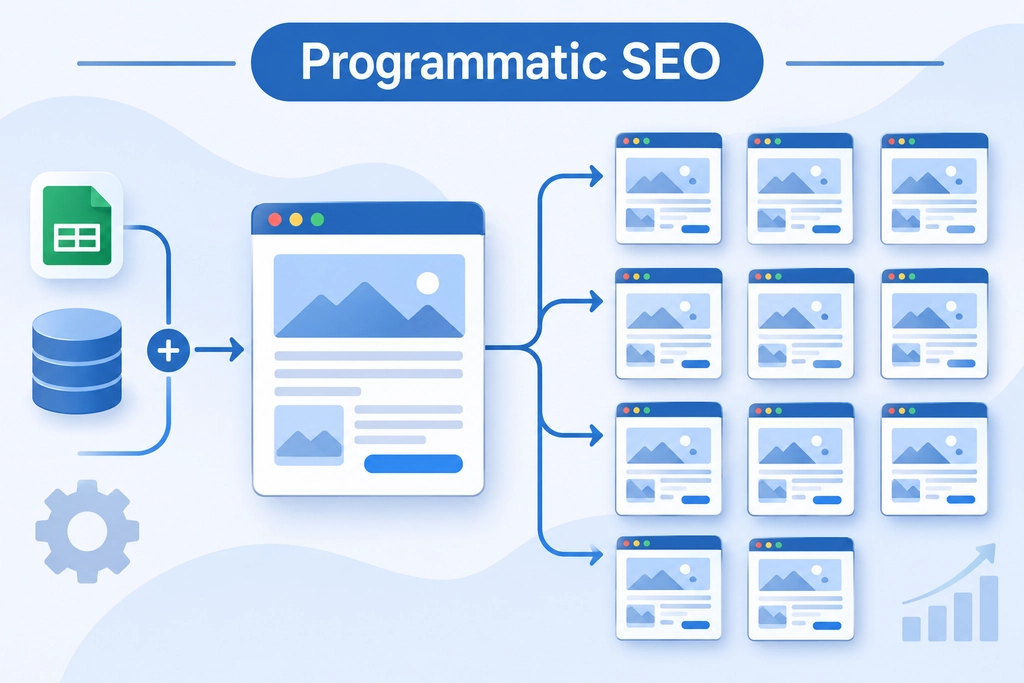
Programmatic SEO uses one page template plus a structured dataset to publish thousands of search-ready pages at once, often launched within six weeks.
Understanding Programmatic SEO
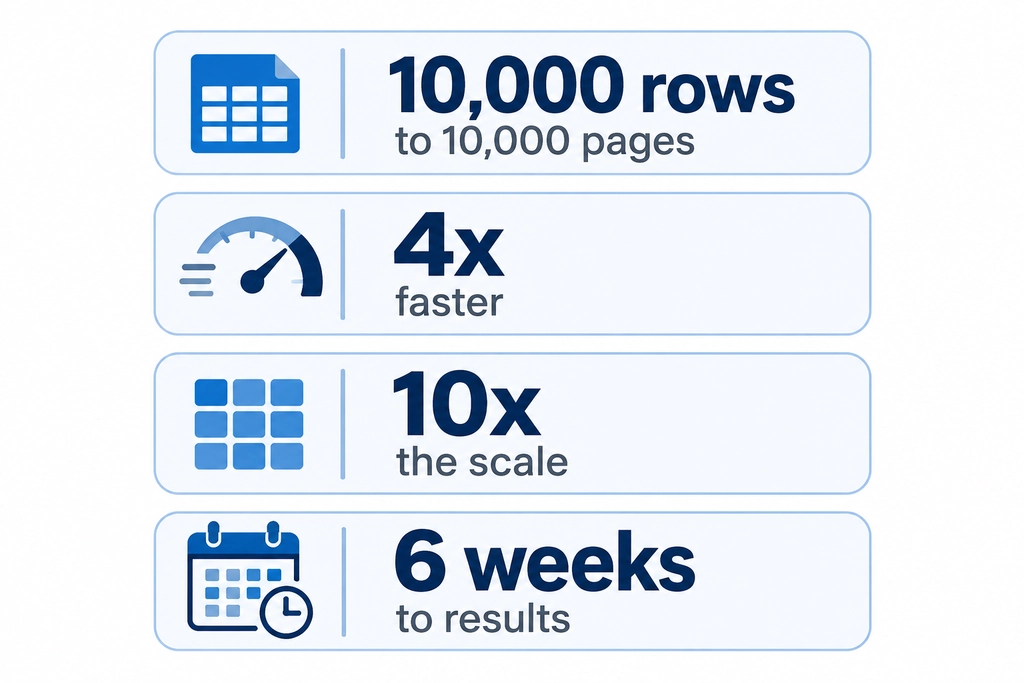
Programmatic SEO is a method of building large numbers of search-optimized pages by combining one page template with a structured dataset. Instead of writing each page by hand, a team feeds rows of data into a template, and the system outputs a finished page for every row. The scale can be enormous: a single template paired with 10,000 rows of data can produce 10,000 indexable pages, each aimed at a slightly different search query, according to Vizup.
Why does this matter? Because most websites cannot realistically write thousands of unique articles by hand. Programmatic SEO solves that bottleneck.
Industry sources describe the process differently depending on how granular they want to get. Exploding Topics frames it as a four-stage process covering keyword discovery, template design, automated publishing, and ongoing optimization. Vizup breaks the same idea into a five-stage loop, starting with scalable keyword research and warning that skipping any stage makes the system fragile. Both views agree on the core mechanic even if the stage count differs.
Speed is often the selling point. Area Ten reports that its approach can produce results in as little as six weeks, moving four times faster and covering ten times the scale of conventional SEO work. For teams wanting to get started with programmatic SEO, understanding these fundamentals before building anything is the first real step.
What is Keyword Clustering?
Keyword clustering is the practice of grouping related search terms into sets based on shared meaning or user intent, rather than treating every keyword as a separate target. For programmatic SEO, clustering is what turns a messy spreadsheet of thousands of search terms into an organized dataset a template can actually use.
Without clustering, a programmatic project risks producing pages that compete against each other or confuse search engines about which page answers which query.
Here is how keyword clustering aids programmatic SEO in practice: a dataset of city names, a dataset of product categories, or a dataset of integration partners all represent clusters where one page template can serve every entry. n8n, for example, builds thousands of individual integration pages that each match a distinct long-tail query tied to a specific software pairing, as documented by Smart Click Agency. That is keyword clustering in action at a company scale.
Programmatic SEO keyword clustering typically starts by identifying a repeatable pattern in search demand, such as ‘[tool] integration with [tool]’ or ‘[city] apartments for rent’. Once that pattern is confirmed, the cluster becomes the backbone of the dataset.
For a deeper look at grouping methods, see this breakdown of keyword clustering and its impact on SEO strategy.
Getting the cluster right before building templates saves significant rework later, since the template structure depends entirely on what the clustered data looks like.
Steps to Implement Programmatic SEO
Programmatic SEO fundamentals follow a repeatable sequence, and skipping steps tends to produce thin or duplicate-feeling pages. Exploding Topics outlines a four-stage version of this process, while Vizup describes a five-stage loop; the steps below merge both views into a practical sequence.
- Identify a keyword cluster with scale, such as a pattern that repeats across hundreds or thousands of search queries.
- Build or source a structured dataset that matches the cluster, with one row per target page.
- Design a page template with placeholders for the variable data, keeping a consistent layout and clear on-page structure.
- Automate the page generation and publishing process so new rows become live pages without manual coding.
- Monitor performance and refine the template or dataset based on indexing and ranking behavior over time.
The dataset is the part most teams underestimate. A template is only as good as the structured data behind it, and thin or inconsistent data produces thin, inconsistent pages. This is also where content uniqueness risk becomes a real concern, since templates that rely too heavily on repeated phrasing can trigger quality issues in search engines.
Human oversight remains necessary even in a largely automated system. Reviewing a sample of generated pages before full publication catches formatting errors, broken data, or awkward phrasing that a template alone will not catch.
Area Ten’s claim of results within six weeks assumes this sequence runs cleanly from keyword research through publishing, without delays caused by missing data or template rework.
Successful Examples of Programmatic SEO
Several companies have used programmatic SEO for years, well before it became a widely discussed tactic. Vizup, citing Semrush, names Zillow, TripAdvisor, and Zapier as long-standing examples, each applying the model to real estate listings, travel content, and integration pages respectively.
In the software sector, Smart Click Agency points to n8n, HubSpot, Atlassian, Zapier, and WebFlow as companies running programmatic integration or directory pages at scale. n8n alone builds thousands of individual pages matched to specific software pairing searches.
Exploding Topics documents additional examples across industries: Amazon uses programmatic product pages, HotelTonight applies the model to travel listings, and Yelp generates location and category pages at scale.
A smaller but instructive case comes from Flow Agency, which documents MentorCruise, a mentorship marketplace, using programmatic pages to target queries tied to specific mentor categories and skills. This example matters because it shows the model is not limited to giant companies with engineering teams; a focused dataset and a well-built template can work for a niche marketplace too.
Across these examples, the common thread is a clear, repeatable keyword cluster paired with a dataset large enough to justify automation rather than manual writing.
Key Metrics for Success
Measuring programmatic SEO requires tracking both page-level and dataset-level performance, since a single underperforming template can affect thousands of pages at once.
High scalability and speed scores reflect why companies pursue this model in the first place, but the lower content uniqueness risk score is a warning sign worth taking seriously. Pages built from thin data templates can read as repetitive to both users and search engines.
Traffic outcomes can be substantial. A guide from Search Engine Land, referenced by Learning SEO, is titled ‘Programmatic SEO: Your missing link to 1M+ sessions,’ pointing to the scale of traffic some implementations have reached.
Tracking indexing rate, organic sessions per page, and average ranking position by cluster gives a clearer picture than overall site traffic alone, since it isolates which clusters are performing and which need template or data adjustments.
The Future of Programmatic SEO
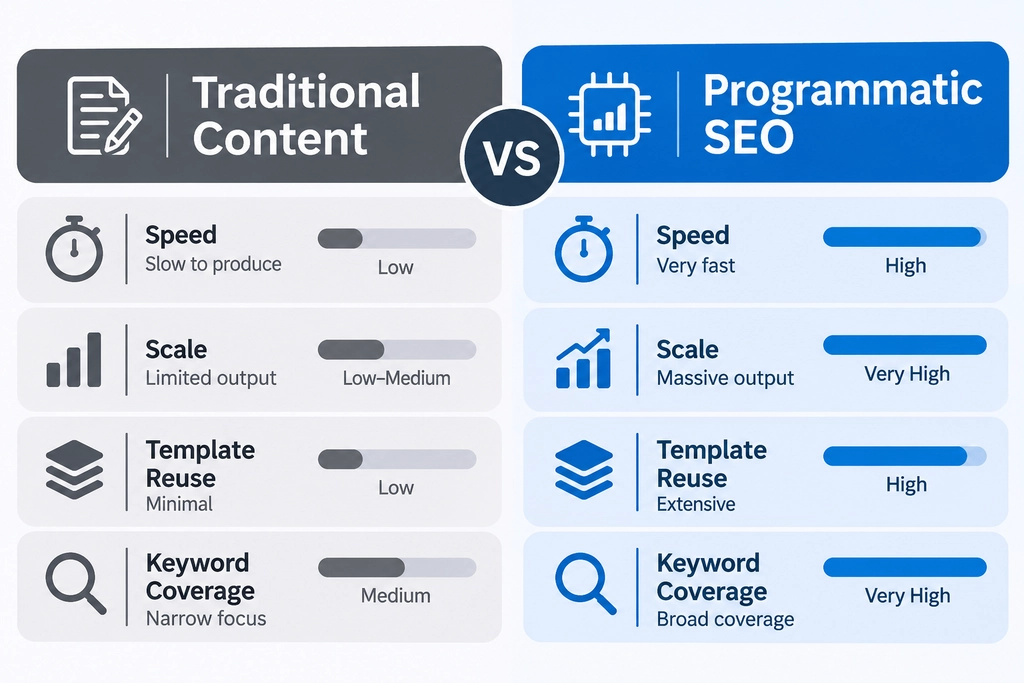
Programmatic SEO has moved from a niche tactic to a documented strategy referenced across guides from 2023 through 2026, with Flow Agency, Exploding Topics, and Vizup each publishing frameworks during that span. The core mechanic has not changed: one template, one structured dataset, many pages.
What has shifted is scale and speed. Vizup’s five-stage loop and the ability to turn 10,000 rows into 10,000 pages reflect a model built for larger datasets and faster publishing cycles than earlier versions of the tactic allowed.
Area Ten’s claim of results within six weeks, at four times the speed and ten times the scale of conventional SEO, suggests the gap between programmatic and manual content production will likely keep widening.
Companies like Zillow, TripAdvisor, Zapier, and n8n show the approach working across very different industries, from real estate to software integrations. For teams weighing whether to build their own system, the fundamentals covered here, from keyword clustering to dataset design, remain the starting point regardless of how the tools around pSEO continue to change.
Key data summary
| Metric | Value | Source | Year |
|---|---|---|---|
| pSEO process stages (Exploding Topics) | 4 stages | Exploding Topics | 2025 |
| pSEO process stages (Vizup) | 5 stages | Vizup | 2026 |
| Dataset rows to pages ratio | 10,000 rows to 10,000 pages pages | Vizup | 2026 |
| Area Ten speed advantage over conventional methods | 4x multiplier | Area Ten | 2025 |
| Area Ten scale advantage over conventional methods | 10x multiplier | Area Ten | 2025 |
| Area Ten results timeframe | 6 weeks | Area Ten | 2025 |
| Named example companies using pSEO (SaaS guide) | n8n, HubSpot, Atlassian, Zapier, WebFlow companies | Smart Click Agency | 2026 |
| Named example companies using pSEO (Vizup) | Zillow, TripAdvisor, Zapier companies | Vizup (citing Semrush, 2025) | 2025 |
| Example site using programmatic pages (e-commerce) | Amazon company | Exploding Topics | 2025 |
| Example site using programmatic pages (travel) | HotelTonight company | Exploding Topics | 2025 |
| Example site using programmatic pages (reviews) | Yelp company | Exploding Topics | 2025 |
| Mentorship marketplace pSEO example | MentorCruise company | Flow Agency | 2023 |
| Listed external pSEO guide authors | Jenny Romanchuk, Ryan Law, Jake Gronsky, Luciano Viterale, Ian Nuttall authors | Learning SEO | 2025 |
| Search Engine Land guide traffic claim | 1,000,000+ sessions | Learning SEO (citing Search Engine Land) | 2025 |
| Template dependency on structured data | Scalability rating | Baja Digital Marketing | 2023 |
Methodology
Stage counts for the programmatic SEO process vary by source (four versus five stages), so readers should treat these as different ways of grouping the same work rather than conflicting facts. Traffic and speed claims, like the six-week timeframe or 1M+ sessions figure, come from specific case examples and are not guaranteed outcomes for every site or dataset.
- Sources consulted: 8
- Sources cited: 6
- Data range: 2025-01-01 to 2026-11-04
- Freshness: 2 current-year, 4 last-year, 0 older
- Update schedule: Quarterly
Frequently Asked Questions
What is programmatic SEO?
Programmatic SEO means using one page template plus a large dataset to build many pages at once, each aimed at a slightly different search term. Vizup notes that a single template paired with 10,000 rows of data can turn into 10,000 indexable pages, each one answering a specific query instead of one broad page trying to cover everything.
How many steps are in the programmatic SEO process?
Sources disagree slightly on the count. Exploding Topics lays out four stages: finding keywords at scale, building a template, automating content creation and publishing, then ongoing tweaks. Vizup describes a five-stage loop that starts with scalable keyword research. Either way, skipping a stage, especially keyword research, tends to make the whole system fall apart.
How fast can programmatic SEO produce results?
Area Ten claims its programmatic approach can show real results in as little as six weeks, running at four times the speed and ten times the scale of older, manual methods. That said, speed depends heavily on how clean your dataset is and how well your template matches searcher intent, so six weeks is not a hard rule for every site.
Which companies use programmatic SEO?
Several well-known brands rely on it. Vizup, citing Semrush, points to Zillow, TripAdvisor, and Zapier as long-term users. Exploding Topics adds Amazon, HotelTonight, and Yelp as examples where each listing or city page is generated from a shared template. Smart Click Agency names n8n, HubSpot, Atlassian, and WebFlow as SaaS companies doing the same with integration pages.
How does keyword clustering fit into programmatic SEO?
Keyword clustering groups similar search terms so one template can serve them all, rather than writing a separate page for every minor variation. This is why Exploding Topics lists keyword identification as the first of its four stages, and Vizup places scalable keyword research at the start of its five-stage loop. Good clusters keep pages from competing with each other.
Can programmatic SEO work for SaaS companies?
Yes. Smart Click Agency points to n8n, which builds thousands of individual integration pages so each one matches a long-tail search like ‘connect [tool A] to [tool B].’ This pattern works well for SaaS because integrations, features, and comparisons naturally repeat across a large but structured dataset, making them easy to template.
What kind of traffic results has programmatic SEO produced?
Learning SEO lists a guide by Jake Gronsky titled ‘Programmatic SEO: Your missing link to 1M+ sessions,’ showing that large traffic gains have been tied to this approach in real case studies. Results like this usually come from building thousands of pages over time rather than a quick one-time launch, so patience and consistent template quality matter.
What industries commonly use programmatic SEO?
Travel, e-commerce, reviews, and mentorship platforms all use it heavily. Exploding Topics names HotelTonight for travel, Amazon for e-commerce, and Yelp for reviews, while Flow Agency points to MentorCruise as an example in the mentorship marketplace space. Each of these industries has large, repeatable datasets, like cities, products, or mentor profiles, that fit the template model well.
Is programmatic SEO faster than traditional content writing?
According to Area Ten, programmatic SEO can run at roughly four times the speed and ten times the scale of conventional content methods. This is because one template, once built and tested, can generate hundreds or thousands of pages, while traditional writing needs a new article drafted by hand for every single topic.
How does keyword clustering aid programmatic SEO?
Keyword clustering groups related terms to create pages that effectively cover various user queries and improve search visibility.

Sources & References
- Programmatic SEO: What It Is and How It Works in 2026, Vizup — tryvizup.com
- A Beginner’s Guide to Programmatic SEO (2025), Exploding Topics — explodingtopics.com
- A Step-by-step Guide to Getting Started with Programmatic SEO, Area Ten — areaten.com
- Programmatic SEO for SaaS: Implementation Guide (2026), Smart Click Agency — smartclick.agency
- Learn Programmatic SEO with Learning SEO, Learning SEO — learningseo.io
- Scaling Organic Traffic with Programmatic SEO: Examples and How-to, Flow Agency — flow-agency.com
Last updated: November 4, 2026